

If you search online, you will see one number everywhere: Boston University acceptance rate. Most students misunderstand what that number actually means. They either panic unnecessarily or become overconfident. Both reactions are wrong.
This guide explains the acceptance rate of Boston University in the simplest and most realistic way so you understand your real chances in 2026.
Quick Summary (Simple Explanation)
- Boston University acceptance rate: around 11%
- Out of 100 applicants, about 11 students get admitted
- Acceptance rate does NOT equal your personal chance
- Strong preparation can move you above the average pool
Now let’s break this down properly.
What Is an Acceptance Rate?
Acceptance rate means:
The percentage of students admitted compared to total applicants.
Example:
- 80,000 students apply
- 8,800 students admitted
👉 Acceptance rate = 11%
It does NOT mean BU randomly selects 11 out of 100 students. Admissions are not a lottery.
They choose students based on profile strength.
Why Boston University Acceptance Rate Became So Low
Ten years ago, Boston University was much easier to enter. Today it is highly selective because of three major reasons:
1. Massive Increase in Applications
More international students apply every year, especially from:
- Asia
- Middle East
- Pakistan
- India
- China
More applicants = lower acceptance rate.
2. Test-Optional Policy
After SAT became optional, many more students applied because barriers reduced.
Applications increased faster than available seats.
3. Strong Global Reputation
BU improved rankings, research output, and career placement, making it more attractive worldwide.
Acceptance Rate vs Difficulty (Important Difference)
Students assume:
11% acceptance rate = impossible admission.
Wrong.
Acceptance rate shows competition, not impossibility.
Think of it like this:
| Applicant Type | Realistic Chance |
|---|---|
| Excellent profile | High |
| Strong academics | Moderate |
| Average profile | Low |
| Minimum requirements only | Very Low |
Your profile matters more than overall statistics.
Average Profile of Admitted Students
Boston University does not publish strict cutoffs, but admitted students typically have:
Academic Performance
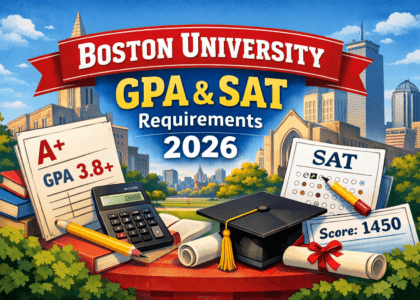
- GPA equivalent: 3.7–4.0
- Strong academic subjects
- Consistent grades
English Scores
- IELTS: 7.0+
- TOEFL: 95+
Activities
- Leadership roles
- Projects or internships
- Community involvement
Essays
- Personal and authentic
- Clear academic goals
Students who meet only minimum requirements rarely stand out.
Why Many Qualified Students Still Get Rejected
Here is the uncomfortable truth.
Thousands of applicants are academically qualified. BU rejects many because:
- Similar academic profiles
- Limited seats
- Weak essays
- No clear direction
- Generic applications
Admissions officers build a balanced class, not just a list of top scores.
They want diversity in:
- Interests
- Backgrounds
- Talents
- Perspectives
Acceptance Rate for International Students
Universities rarely publish exact international acceptance rates, but typically:
👉 International acceptance rate is lower than overall rate.
Reason:
- Fewer seats
- Financial aid limitations
- Higher academic expectations
For Pakistani students, competition is strong because applicants often apply to popular majors like:
- Computer Science
- Business
- Economics
- Engineering
These programs are more selective.
Early Decision vs Regular Decision Acceptance
Applying early can improve chances.
Early Decision (ED)
- Binding commitment
- Higher acceptance probability
- Shows strong interest
Regular Decision (RD)
- Largest applicant pool
- More competition
Students serious about BU often apply Early Decision strategically.
Biggest Misconceptions About Acceptance Rate
❌ Myth 1: Only toppers get in
False. BU admits well-rounded students, not only perfect scorers.
❌ Myth 2: Acceptance rate defines your future
Wrong. Many rejected students later succeed at equally strong universities.
❌ Myth 3: SAT optional means easier admission
Actually the opposite. Competition increased.
How to Improve Your Admission Chances
Instead of worrying about acceptance rate, focus on controllable factors:
1. Strong Academic Performance
Grades remain the strongest predictor.
2. Build Real Activities
Depth matters more than certificates.
3. Write a Strong Essay
Explain:
- Why your major
- Why BU
- Your long-term goals
4. Apply Early
Early applicants statistically perform better.
5. Choose Major Strategically
Highly competitive majors reduce chances.
Realistic Admission Mindset
Here is the honest perspective:
- Boston University is selective.
- Admission is difficult but achievable.
- Preparation matters more than statistics.
Students fail when they treat BU as either:
- Impossible dream, or
- Guaranteed backup.
It is neither.
Simple Analogy (Easy Understanding)
Imagine 100 strong runners competing.
Only 11 finishers get selected.
If you train properly, you compete among top runners. If you prepare poorly, the acceptance rate becomes irrelevant because rejection is certain.
Final Takeaway
Boston University’s acceptance rate looks scary because it represents global competition. But admissions are profile-based, not random.
Focus on building a strong application instead of obsessing over percentages.
If your academics, activities, and story align well, you can absolutely be among accepted students.